 £
£
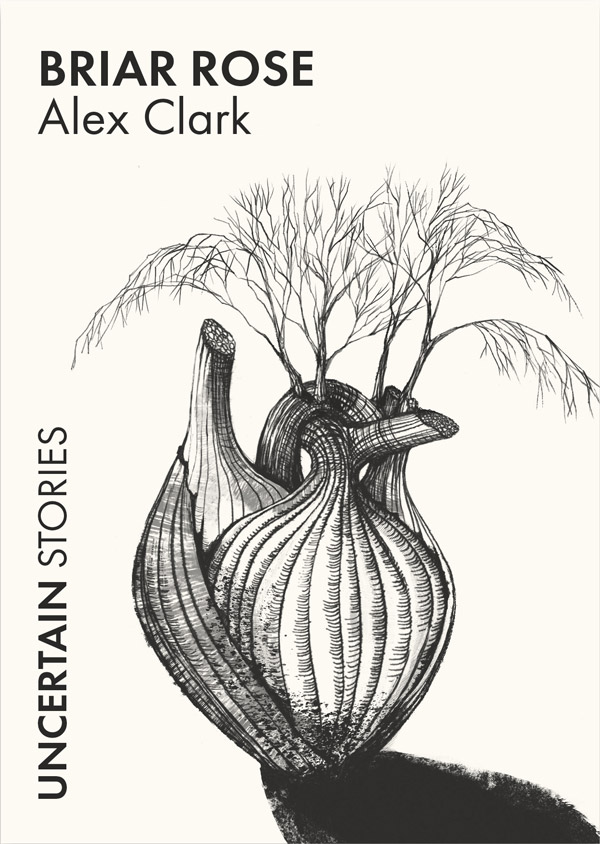
Alex Clark's short story Briar Rose was published in our first set of Little Uncertainties. Here she's kindly agreed to answer some questions for us about reading, writing, and Briar Rose itself.
Q & A with Alex Clark
Can you tell us anything about the inspiration behind your story Briar Rose?
At the time I wrote this story, I lived in a suburban semi-detached house where I grew vegetables in my front garden. On one side I had neighbours who were fanatically neat and tidy, and on the other, neighbours who were shambolic. The shambolic neighbours allowed their roses, hedge, lawn and Leylandii to grow exactly as described in Briar Rose. The neat neighbours had a razor-edged lawn and cowed shrubs they obsessively clipped.
I was quite annoyed by the shambolic neighbours (their Leylandii were blocking our satellite signal, just like James’s), but felt the neat neighbours had oppressive energy. I wished they would let their shrubs be plant-shaped, and stop vacuuming all the bits off their lawn with a massive noisy leaf vacuum. The story came to me when one day in my front garden I thought that the shambolic neighbour’s house looked like the castle in Sleeping Beauty. What would the story look like if you were a gardener, and on the side of the roses rather than the sword? What kind of love would you need to keep hidden?
Over the years you’ve worked in many different fields: your author bio lists industrial archaeologist, stonemason, and gardener. This story draws on the last of those, and you’ve also written some fantastic spooky stories about our relationship with buildings. How central would you say your work experience is to your writing, and do you find that you’re actively developing stories while you’re at work, or is it something that comes later, when you look back?
I’ve been writing for quite a while now, and it’s instructive to look back at my work and notice my own obsessions. I’m very interested in atmospheric settings, ghosts, and other worlds. I write a lot about nature as something sentient, powerful, even hostile, and about people who are in some part supernatural, or out of step with the everyday. Those fascinations have been around since I was quite young, as has my own feeling of being slightly at an angle to the ordinary world. I would say the jobs I’ve chosen, the fact I write, and the type of stories I write are all products of those feelings and interests, and by my attraction to deep, meticulous work.
My work has gifted me an awful lot of story seeds, because it is such a huge portion of my life, but stories have also come to me from so many other places. I don’t actively develop short stories at work, but then I don’t think I actively develop short stories full stop. They seem to just turn up, usually with most of their component parts, and just need a bit of pulling around to get them in the right form. Often it’ll only be when they’re finished that I can trace their origin, and identify what in my life influenced them.
What attracts you to writing short stories in general?
They’re an absolute blast – almost a high. Novels are gruelling, but a short story is something I can write in a day or two, in an instinctive outpouring which doesn’t much involve my analytical brain. I love how intense short stories are, how much meaning and mood you can pack into them. They feel like magic.
And how about the appeal of supernatural or speculative fiction? What draws you to using those ideas in your work?
Firstly, I just enjoy reading those kinds of stories. When I write books, I think of what I love to read, the kind of story I wish existed, and I try to make that. It’s like making an imaginary guest a delicious meal. I want to read ‘literary’ fiction that also has ghosts and ancient curses and sentient trees, so that’s what I write. Secondly, when we tell stories about ghosts we’re often using them to talk about very real and human things like memory, legacy, morality, transgression and love, and all of those are excellent and timeless story ingredients.
I want to read ‘literary’ fiction that also has ghosts and ancient curses and sentient trees, so that’s what I write.
When and where do you most enjoy writing?
In the morning, in complete silence, at home. I’m not a coffee shop writer. I’ve been known to wear ear defenders in my own empty house, if the outside world’s not quiet enough.
Moving on to your own reading, what’s your ideal time and place to read?
I always read in bed before going to sleep, though often that’s comfort reading: PG Wodehouse is my perfect pre-sleep read. Otherwise, if I’m absorbed in a book I just carry it with me and read it at every opportunity.
Briar Rose is part of our Little Uncertainties project here at Uncertain Stories, through which we’re distributing free short story booklets to readers (and potential readers!) across the country through cafes and bookshops. If you could give copies of one short story – classic or modern – to everybody in your own home town, which story would you choose, and why?
As I write this it’s October, so for spooky season I’d give everyone A View from a Hill by M R James. It features an evil archaeologist, architectural clues, ungodly rituals and vengeance from beyond the (shallow) grave. Apologies for the nightmares.
Do you have a favourite memory of reading a book or story? Maybe a moment that really left an impression on you?
There are so many moments. When it comes to short stories, I remember reading a story by Muriel Spark called Miss Pinkerton’s Apocalypse, in which a couple is menaced by a tiny flying saucer which enters their house through an open window. It is a wonderfully bizarre, cryptic little story, totally unconcerned by its own eccentricity. Reading it, I felt freed to be as strange in my writing as I wanted to be. In books, Sarah Waters’ The Little Stranger was absolutely seminal for me. A fantastic literary ghost story with the most incredible twist which I still think about years after reading.
Finally, do you have a favourite independent bookshop you think people should visit?
I’d like to recommend the whole of Hay-on-Wye for hours of happy browsing.